
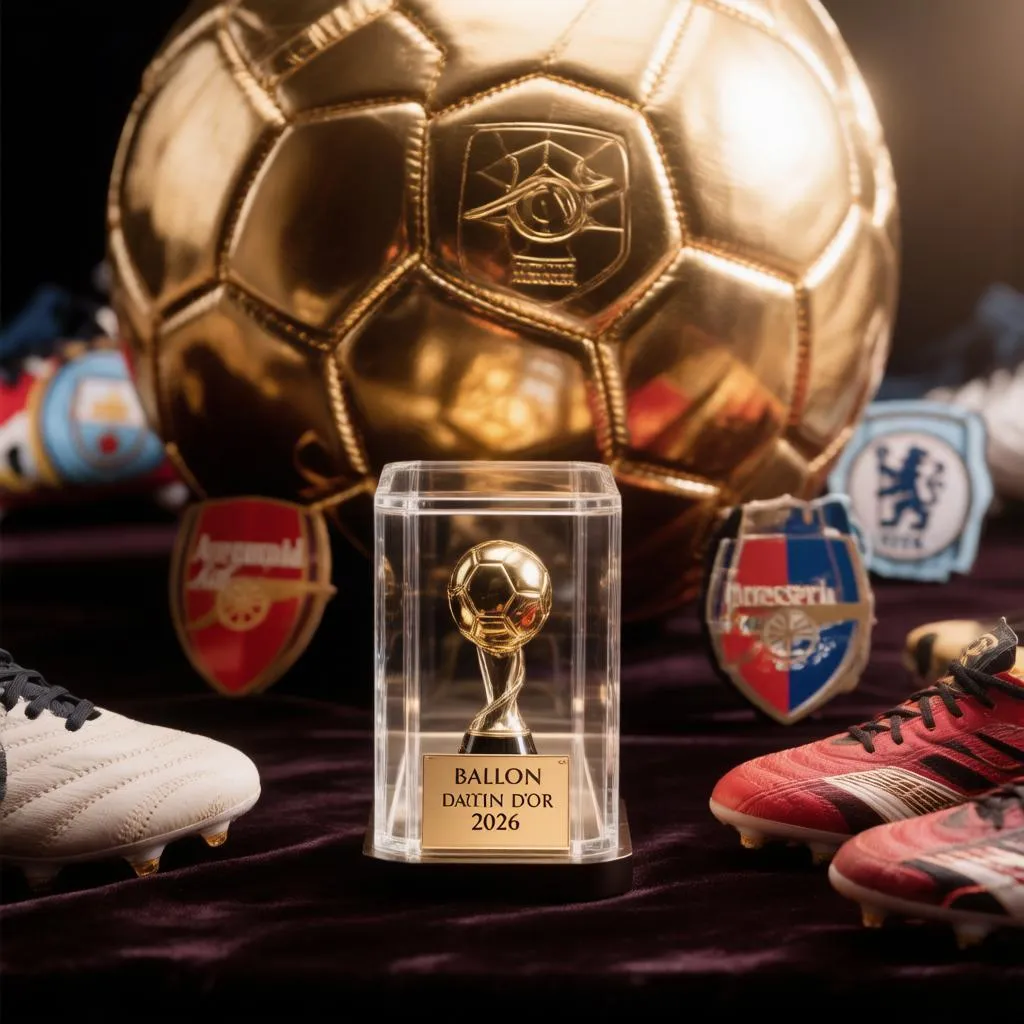
For the first time in its 70-year history, the Ballon d’Or is leaving Paris. On Monday 26 October the ceremony arrives at the London Palladium — a deliberate tribute to Stanley Matthews, the award’s first winner — and it lands in the most awkward possible week for the host country’s league. Five Premier League players sit on the 30-man shortlist, more than enough to fill a household debate, yet not one of them is the bookmakers’ favourite. That honour belongs to Harry Kane, an England captain who scores his goals in Munich, while the World Cup that dominated the summer handed the tournament’s biggest individual prizes to players of Spain and, once again, to Paris.
So where do the English league’s candidates actually stand? The honest answer is: nominated, respected and realistically second-tier — and the reasons why say a lot about how the modern Ballon d’Or is won.
Why this year’s vote feels different
Every Ballon d’Or is shaped by its voting window, and the 2026 edition covers the period from 3 August 2025 to 19 July 2026 — a span that swallows a full club season and a World Cup in one bite. That structure always rewards players who peak twice, and this cycle did so with unusual cruelty. Spain lifted the World Cup trophy with Rodri collecting the tournament’s Golden Ball; France’s Kylian Mbappé set an all-time record with ten World Cup goals; Norway’s run, powered by Erling Haaland’s seven, ended only in the knockout rounds and earned him a Team of the Tournament place; and Lionel Messi, at 39, produced eight goals and four assists for Argentina while winning a second straight MLS MVP award and a first MLS Cup with Inter Miami.
Against that backdrop, the Premier League’s case rests on a season that was historically strong domestically but trophy-light by European standards. Arsenal won the title with a defence for the ages and reached both the Champions League and EFL Cup finals; Manchester City pushed them to the wire while lifting the FA Cup and Carabao Cup; Manchester United rode a record-breaking Bruno Fernandes campaign to third place. Individually, the numbers are staggering. As a collective narrative — “the best player on the planet came from the best league” — it falls short of a Spain World Cup or a Paris Saint-Germain side defending its European crown.
The five Premier League names on the shortlist
The nominees were announced on 8 September, and the Premier League’s representation spreads across six clubs and thirteen of the ceremony’s award categories — but the main men’s prize comes down to five players. Each arrives with a genuinely elite season behind him and one specific obstacle in front of him:
| Player | Club | 2025-26 season highlights | World Cup 2026 role | The case — and the catch |
|---|---|---|---|---|
| Erling Haaland | Man City | 58 goals in 64 games; third Golden Boot with 27; FA Cup and EFL Cup winner | 7 goals, Team of the Tournament with Norway | Relentless volume and a title-race push, but no league crown and a second-round exit weaken the platform |
| Declan Rice | Arsenal | 8 goals, 15 assists; league champion; CL and EFL Cup finalist | Exited with Brazil in the round of 16 | Elite all-round midfield season on a title-winning side; missed the decisive penalty in the Champions League final |
| Bruno Fernandes | Man Utd | Record 21 Premier League assists; 13 goals; Playmaker of the season | Carried Portugal’s creative burden | Statistical dominance in a non-elite side; awards voters historically punish that profile |
| Gabriel Magalhaes | Arsenal | Anchored a defence conceding just 27 in 38; clean sheets in half the league season | Part of Brazil’s squad until the last 16 | A title-winning defensive pillar; centre-backs have won the award only twice in football history |
| William Saliba | Arsenal | Same defensive record as Gabriel; ever-present in the run-in | Part of Brazil’s group-stage exit | Same case, same historical ceiling — and splitting Arsenal’s defensive vote may cap both |
The Arsenal concentration is the most interesting wrinkle. Three Gunners on the main shortlist is more than any other club can claim, and it reflects a championship built on structure rather than one galáctico. But Ballon d’Or voting has a gravitational pull toward individual highlights, and three names from the same back line and midfield tend to cancel each other out rather than triple a league’s chances.
How the winner is actually decided
Much of the confusion around the shortlist comes from treating the Ballon d’Or like a fan poll or a stats contest. It is neither. The mechanics matter, because they explain both why Kane leads the market and why the Premier League names may struggle to convert:
- A single jury of journalists. One hundred accredited journalists — one per top-ranked nation in the FIFA men’s ranking — each submit a ranked ballot. There is no player vote, no captain vote and no public weighting.
- A fixed evaluation window. Voting closed on 19 July 2026, meaning the current Premier League season counts for nothing. Everything on the ballot was done between August 2025 and the World Cup final.
- Three published criteria. Individual performances and decisive moments, collective achievements and trophies, and overall class including fair play — in that order of practical weight, judging by recent results.
- A major-tournament multiplier. A World Cup sits inside the window every four years, and history shows a Golden Ball or a winning campaign can lift a candidate several places, as Rodri’s 2024 win and his 2026 tournament form demonstrate.
The practical consequence is that the award tends to crown the player with the best combination of volume, silverware and tournament peak. Kane’s case — an astonishing 73 goals for club and country — checks the volume box almost perfectly, while his critics point to the silverware column, a question that has followed the 33-year-old through an otherwise untouchable calendar year. A Kane victory would make him the first English winner of the men’s award since Michael Owen in 2001, and the first to win it while playing his club football abroad.
Where the EPL candidates realistically rank
Strip away the shortlist’s ceremonial gloss and the market has converged on a fairly stable hierarchy, with the Premier League’s five occupying a band just below the genuine frontrunners:
- Lamine Yamal — the bookmakers’ season-long favourite: 26 goals and 21 assists, La Liga and the World Cup won at 19, on course to become the youngest winner in the award’s history.
- Lionel Messi — 44 goals, 30 assists, an MLS Cup and a virtuoso World Cup at 39, in his 17th nomination; sentiment plus substance is a dangerous mix for the field.
- Kylian Mbappé — 58 goals, 14 assists and a record ten World Cup goals; the eternal candidate whose case grows harder to dismiss every year.
- Rodri — a Golden Ball on a World Cup-winning Spain, despite a season at Barcelona that never fully recaptured his pre-injury form; recent precedent says voters forgive the club dip.
- Kvaratskhelia and the PSG block — Champions League winners again, but Georgia’s absence from the World Cup caps the Georgian’s ceiling while Vitinha and Fabián Ruiz split the club’s internal vote.
- Haaland and the EPL five — the league’s strongest hand, with Haaland’s volume the closest thing to a genuine podium threat and Rice’s title season quietly respectable; Fernandes, Gabriel and Saliba remain longshots against this field.
Nothing about that order is guaranteed. The Ballon d’Or has produced genuine upsets when narratives collide — Ousmane Dembélé’s win in 2025, a season after injuries had apparently removed him from contention, is the freshest example, and he is nominated again despite a disrupted first half of the campaign. A ceremony on English soil, with English journalists, England international Bellingham also on the ballot, and the Matthews tribute framing the whole evening, gives the Premier League contingent a stage no candidate has enjoyed before.
The English drought and the structural problem
The longer context is uncomfortable for the host league. No Englishman has won the men’s Ballon d’Or in a quarter-century, and the reasons are structural rather than sentimental: the award consistently gravitates toward players who win the Champions League or a major international tournament in the same season, and English players have rarely controlled both levers. The Premier League’s nominated five illustrate the problem with painful symmetry — Haaland has the goals but the trophies sit with club cups, Fernandes has the numbers without the team success, and Arsenal’s trio have the title but shared a Champions League final defeat and an early Brazilian World Cup exit.
There is also a subtler factor working against defensive candidates. Gabriel and Saliba anchored arguably the most impressive defensive season in modern Premier League history, but the award has gone to a centre-back only twice — Lev Yashin’s goalkeeper win and Fabio Cannavaro’s 2006 — and a voting window that included Spain’s attacking World Cup triumph offers little incentive to break that pattern now.
What Monday decides
By Monday night, one of three narratives will exist. Either Kane finally converts historic volume into the game’s highest individual honour, ending a 25-year English drought from a German stage; or Yamal, at nineteen, redraws the award’s age curve while adding a World Cup medal to a league title; or Mbappé, Messi or Rodri converts the World Cup summer into a career capstone. For the Premier League’s five, the realistic best outcome is a podium presence for Haaland and a respectable top-ten finish for the rest — a result that would still mark the league’s strongest collective showing in years, even if the trophy boards a plane out of London.
And the longer game matters more than one evening. The 2026/27 season is already three matchdays old, Arsenal and City are unbeaten domestically, and the next vote’s window opens for a new campaign in which the league’s Champions League contingent — five clubs, three currently inside the top eight — has its deepest European field ever. If an English club wins the Champions League in Madrid next June, the 2027 Ballon d’Or conversation will look very different from this one. For now, the Premier League’s candidates head into a London ceremony as gracious nominees in someone else’s party — the league’s next chance to host a winner of its own starts the following weekend.