
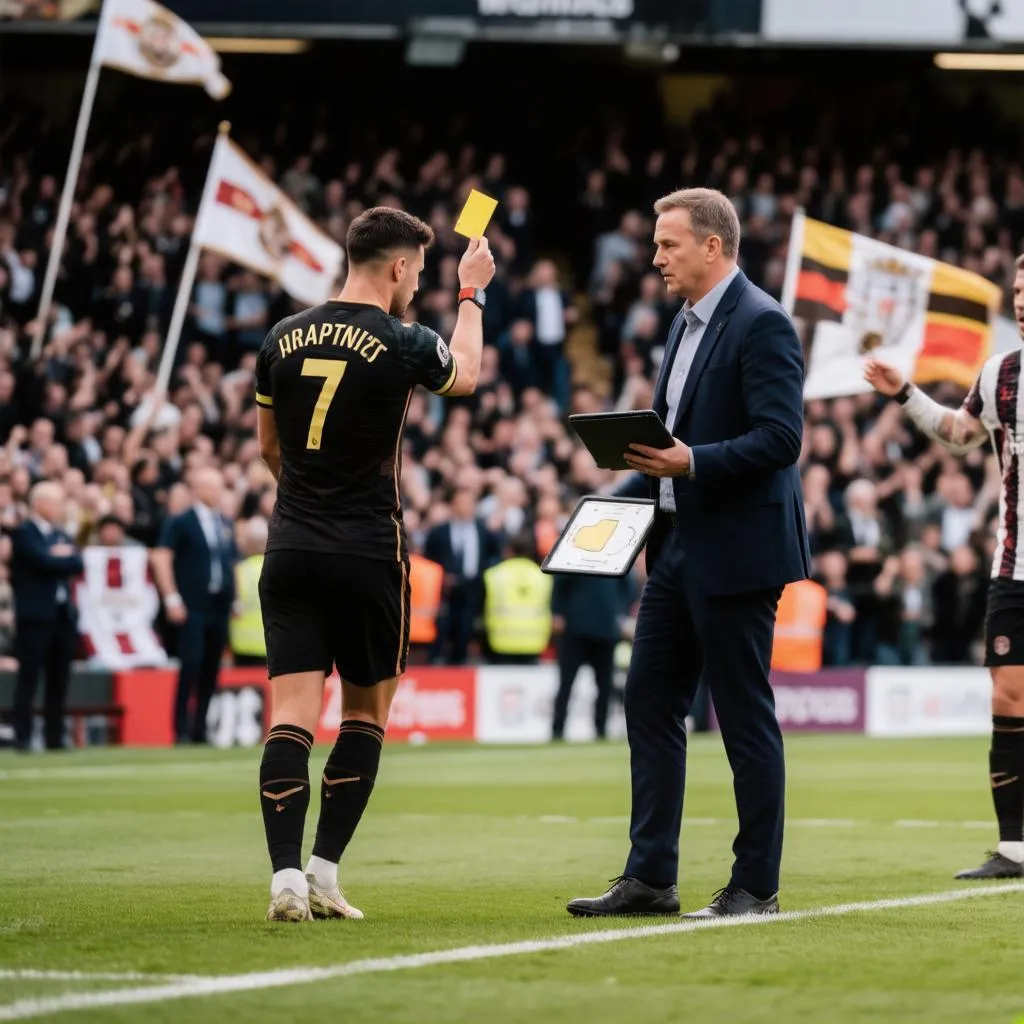
Anyone who follows the Premier League closely will have seen the familiar sight of a manager staring anxiously at the fourth official after a booking. A yellow card seems like a small punishment on its own, but in the Premier League bookings quietly build up towards something far more serious: a ban that removes a player from matches he would otherwise be able to play in. The system confuses plenty of fans because it works differently from red cards, applies only to certain competitions, and has specific cut-off points during the season. Here is how the whole mechanism works, from the first booking to the moment a player is told he cannot travel with the squad.
Why bookings can lead to a ban
The disciplinary system in English football treats accumulated yellow cards as a separate matter from straight red cards. A red card produces an immediate suspension, while yellow cards only become a punishment once a player collects enough of them within a single season. The idea is simple: one booking might be an accident of timing, but a running total shows a pattern of indiscipline that the league wants to discourage.
Crucially, only yellow cards received in Premier League matches count towards Premier League suspensions. Bookings picked up in the FA Cup, the Carabao Cup or European competitions run under their own separate tallies, so a player can be walking a disciplinary tightrope in the league while staying clean in cup football.
The thresholds and cut-off points
The Premier League operates a tiered system, where the punishment grows with the number of bookings. Each threshold has its own deadline in the calendar, which is what makes the timing of a booking so dramatic late in the first half of the season. The full picture looks like this:
| Yellow cards | Cut-off point | Suspension |
|---|---|---|
| 5 | Matchday 19 | One match |
| 10 | Matchday 32 | Two matches |
| 15 | End of season | Three matches |
| 20 | End of season | Decided by a regulatory commission |
The table shows why managers sometimes substitute a player who has been booked in a tense derby. Reaching five yellow cards before the halfway point of the campaign triggers an automatic one-match ban, and that ban is served in the next Premier League fixture. The ten-card rule behaves the same way but with a heavier price: two matches out. After matchday 32, accumulating more yellows no longer triggers the two-match sanction, which means the disciplinary pressure eases in the final stretch even though the fifteen-card rule technically remains in play until the season ends. A twentieth booking is rare enough that it is handled case by case, with a panel deciding on an additional punishment rather than a fixed penalty.
It is worth noting that the count does not reset after a ban is served. If a player picks up his fifth booking, serves one match, and is booked again immediately on his return, he is already one card closer to the ten-card threshold. The tallies keep rolling throughout the season.
How a suspension is actually served
Once a threshold is reached, the ban applies only to Premier League matches. This is one of the most misunderstood parts of the rules, so it helps to spell out the mechanics step by step:
- The player collects the card that takes him to the threshold, and the booking is confirmed after the match.
- The suspension automatically applies to the next Premier League fixture, and the club is notified by the league.
- The player misses that league game but remains eligible for cup matches and European fixtures that fall in between.
- If a cup match is scheduled before the next league fixture, the player can feature there, and the league ban waits for the following league game.
- The total is not wiped clean, so the player continues accumulating bookings towards the next threshold.
The fifth step is where clubs often get caught out. A defensive midfielder who reaches five bookings in November, serves his one-match ban, and then picks up bookings at his usual rate can find himself three or four cards deep into the ten-card territory by spring. Managers with thin squads plan around this, sometimes resting a booked player entirely or asking him to change his tackling habits for a few weeks.
What does not count and what carries over
Several situations that fans assume affect the tally actually do not. Keeping these distinctions in mind is the easiest way to understand why a player is or is not at risk:
- Yellow cards received in the FA Cup and Carabao Cup count towards cup disciplinary records, not the Premier League tally.
- A second yellow in the same match becomes a red card, and that dismissal is punished under the red card rules rather than the accumulation system.
- Yellow cards from previous seasons disappear entirely; every campaign starts from zero.
- Bookings picked up after the relevant cut-off do not trigger that particular level of ban, even though they still appear on the player’s record.
This reset at the start of each season is why commentators talk about players needing to “start again” in August. A defender who reached ten yellows last season carries nothing into the new campaign except the memory of the games he missed.
Appeals, mistaken identity and cancelled cards
Not every yellow card is set in stone. If a club believes a case of mistaken identity occurred — meaning the referee booked the wrong player — it can appeal, and a successful appeal removes the card from the record. Clubs cannot appeal a yellow card simply because they disagree with the decision itself; the protest must be about the identity of the offender. If the challenge leads to a red card instead, the process is different, because straight reds carry a heavier punishment and can be reviewed on the merits of the incident.
Rescinded cards matter enormously for players close to a threshold. A single successful appeal can be the difference between a key midfielder starting a title-deciding fixture and watching it from the stands.
How players and clubs manage the risk
Discipline is treated as a tactical resource. Data departments track every booking, and the difference between a two-week suspension window and a clean week is often visible in team selection. Approaches vary from club to club:
- Rotation around congested fixtures, keeping a heavily booked player out of low-stakes league matches so he avoids the cut-off.
- Instruction to a booked holding midfielder to avoid challenges in his own half, where a yellow is most likely to be given.
- Accepting the risk for indispensable players, on the logic that losing them for one match matters less than losing them for a key phase of the season.
- Timing a deliberate booking when the cut-off has already passed, effectively making the card free of suspension consequences.
That last approach is more common than people realise. Late in the season, once the ten-card window has closed, a booking costs nothing beyond the referee’s frown, and players sometimes take a yellow precisely to break up a dangerous counter-attack.
Why the system works the way it does
The tiered thresholds are designed to punish repeated indiscipline proportionally. Five bookings cost a team one match, ten cost two, and fifteen cost three — the penalty escalates faster than the card count does, which is deliberate. A side whose players are constantly suspended for accumulation is being told, in effect, that its tackling habits are costing points.
The cut-offs add a layer of drama that pure red card rules never produce. Every autumn, fans of clubs with booking-prone players watch the approach to matchday 19 with genuine tension, because the arithmetic is public and unforgiving. The rules are published in advance, the tallies are tracked openly, and nothing is left to discretion — which is exactly why the system, for all its quirks, has stayed essentially unchanged for years.