
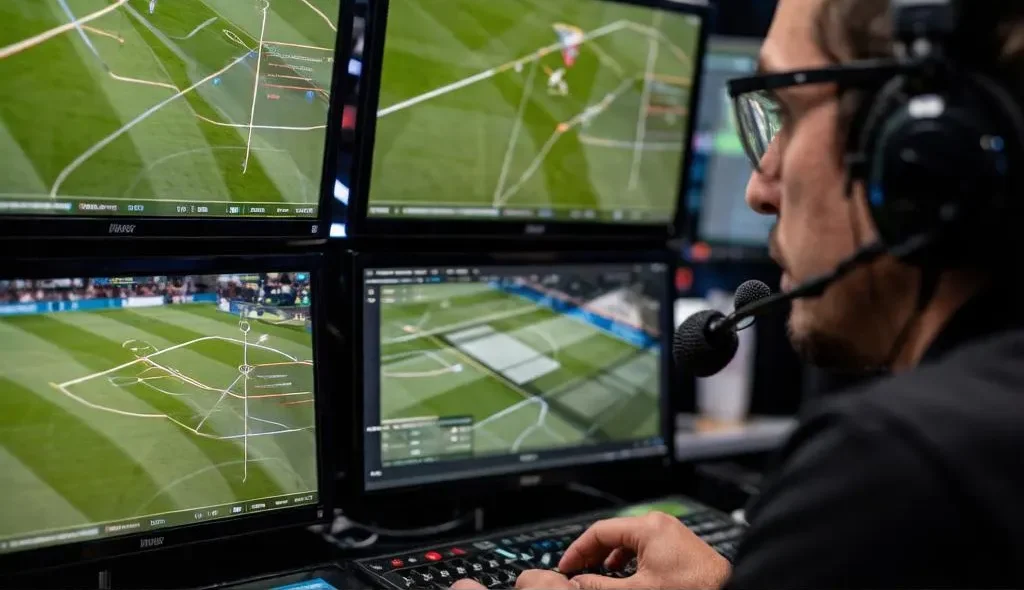
For most of the video assistant referee’s existence, football asked its supporters for something unusual: trust in a process they could neither see nor hear. A decision took ninety seconds, a screen said “VAR check”, and then either the game resumed or it didn’t, with only the referee’s gestures as explanation. That era is ending, unevenly and reluctantly, but ending. Referee audio is being published in some competitions, semi-automated offside technology is explaining its own verdicts on stadium screens, and experimental formats now let match officials explain decisions directly to the crowd. What fans actually hear, though, remains a carefully curated fraction of the conversation — and the gap between the promise of transparency and the reality of it is where the sport’s most interesting governance debate is now happening.
Why transparency became the battleground
The VAR’s acceptance problem was never really about accuracy. Studies of major leagues have consistently shown decision accuracy rising sharply after video review — overturned errors dropped measurably, and most controversial calls are now technically correct. What never improved was the experience of waiting. A penalty review at a packed stadium means tens of thousands of people staring at silence, unable to ask the most basic question: what are they looking at, and what did they decide?
That vacuum filled itself, and not with facts. Supporters filled it with suspicion, pundits filled it with frame-by-frame forensics, and social media filled it with conspiracy theories that hardened into folklore the longer the sport refused to engage. The lesson football has slowly absorbed is that opacity is more expensive than honesty: every unexplained delay costs the technology a little more credibility, and no amount of accurate officiating compensates for a process that feels closed.
The response has arrived in three distinct layers, each with its own politics. Automated explanations, broadcast audio and in-stadium announcements do different jobs, and understanding which is which clarifies what the transparency era has actually delivered so far.
Semi-automated offside: the technology that explains itself
The most successful transparency story so far belongs to the least dramatic upgrade. Semi-automated offside technology — limb-tracking cameras combined with AI that generates the offside line automatically — reached full deployment at the 2022 World Cup and has since rolled into Europe’s biggest leagues. Its contribution to openness is structural: the system produces a 3D visualisation of the decisive moment, rendered within seconds, that can be shown on stadium big screens and broadcast graphics simultaneously.
What makes this genuinely different from the old hand-drawn offside lines is speed and independence. Because the technology detects limbs automatically, the video assistant’s job shrinks from judging to verifying, which cuts typical check times from over a minute to well under thirty seconds. The visualisation shows fans exactly why the flag went up — the attacking player’s toe, frozen millimetres beyond the last defender — rather than asking them to trust a squiggly line drawn by a human hand.
Not everything about it pleases everyone. Purists argue that measuring offsides to centimetres criminalises margins the game was never meant to police, and goal celebrations have become exercises in restraint while everyone waits for the algorithm’s verdict. The technology answered the “is it offside?” question almost perfectly; it has done nothing for the deeper grievance that football’s most exciting moments keep being erased.
Referee audio: what has been released and what hasn’t
The audio question is where transparency gets political, because recordings of officials’ conversations expose both the process and the people in it. Progress here has been real but tightly controlled, and the map of who hears what still varies enormously. The current landscape looks like this:
- Tournament releases after the fact. FIFA and UEFA have published curated VAR audio clips following major tournaments, most notably explanations of key decisions from the 2022 World Cup and subsequent Champions League finals. These are edited, quality-controlled and released days or weeks later — valuable for accountability, useless for immediacy.
- Live audio in some domestic competitions. A handful of leagues have experimented with broadcasting referee-VAR exchanges during matches, either with a short delay or in edited form; others, including England’s top flight, still publish nothing live, releasing occasional clips only for controversial decisions after the game.
- The referee broadcast experiment. The most radical format tried so far takes the concept further: a former referee sits with a broadcast feed and the audio, explaining decisions in real time. Early trials divided opinion sharply — purists hated the intrusion into match flow, but many viewers described it as the first time VAR ever made sense to them.
- What is never heard. Every release comes with the same editorial reality: pauses removed, identifying details redacted, the sharpest exchanges softened. Fans hear the version of the conversation that officials’ bodies consider publishable, which is a form of transparency, but transparency with a gloss.
The pattern across all of these is consistent: football has accepted transparency as a product to be packaged, not a stream to be opened. That is a genuine step forward from total silence, and it is also the reason scepticism has not fully dissolved — a curated clip is evidence, but it is also an argument.
What fans actually hear on a matchday
Strip away the press releases and the matchday experience for an ordinary supporter is still surprisingly thin. Semi-automated offside graphics appear on big screens within seconds, which is the clearest win of the era. Beyond that, the stadium is mostly left to interpret gestures: the referee’s signal for a review, the delay itself, and — in a growing number of competitions — an announcement explaining the outcome. The speed and depth of that communication now differs noticeably from competition to competition:
| Competition | Decision communication at the ground | Referee audio | Offside visualisation |
|---|---|---|---|
| FIFA World Cup | Announcements for reviews; big-screen explanations | Curated clips released post-tournament | Full 3D replay within seconds |
| UEFA competitions | Announcements for VAR decisions | Occasional clips after major finals | Used for semi-automated offside calls |
| Major European leagues | Varies; some leagues announce every review | Mostly nothing live; sporadic post-match releases | Standard in leagues with the technology |
| English Premier League | Stadium announcement of review outcomes only | No live audio; occasional released clips | Present since the technology’s adoption |
| Lower divisions and smaller leagues | Minimal; often no screen or announcement | None | Rare or absent |
The table captures the era’s central inconsistency. Fans at the World Cup final and fans at a second-division Tuesday night match are watching the same laws administered by technologies that communicate with them at completely different levels. Transparency, in practice, is a function of broadcast budget — which means the supporters who most distrust VAR, often at smaller clubs, receive the least explanation of it.
The in-stadium announcement experiment
The boldest frontier is giving referees a voice that reaches the crowd directly, and early trials have been more successful than sceptics expected. Several competitions have tested formats where the referee, or an announcer relaying his explanation, addresses the stadium after a VAR decision — not the full conversation, but the conclusion in plain language: why the penalty stood, what the check found, which law applied.
Feedback from these trials keeps highlighting the same effect: even a ten-second explanation measurably reduces hostility in the ground. A crowd that hears the reasoning may still disagree with it, but disagreement based on facts behaves differently from disagreement based on mystery. The obstacles are practical as much as philosophical — microphones need to reach the pitch cleanly, officials need media training they never signed up for, and every spontaneous phrase becomes broadcast history in an age when a referee’s offhand comment can trend for a week.
The unsolved problems of the transparency era
For all the progress, several issues have proven stubborn, and honesty about them is what separates the sport’s current position from genuine openness:
- Curation versus candour. Every released clip has been edited by the same institutions whose decisions it concerns, which means the audience can never be sure what was left out — the structural flaw at the heart of voluntary transparency.
- The subjective decision gap. Audio and visualisations work beautifully for objective calls — offside lines, ball contact — but the decisions that generate the most fury, handballs and challenges inside the box, remain matters of human judgement that no graphic can resolve.
- Delay as its own problem. The sport has traded mystery for minutes. Even a perfectly explained ninety-second review interrupts football’s rhythm, and no amount of explanation restores a disallowed goal’s emotional explosion.
- Consequence and accountability. Transparency reveals errors but rarely changes anything about them; leagues that publish audio do not publish the disciplinary follow-up, so fans see the mistake without ever learning what happened next.
- The experience divide. As long as explanation depends on stadium infrastructure and broadcast investment, the transparency era will remain a top-flight phenomenon, deepening rather than narrowing the gap between elite and grassroots football.
None of these problems is unsolvable in principle, but each requires football’s authorities to give up discretion they currently hold — and that, more than any technical barrier, is what has kept the pace of change slow.
Where the transparency era is heading
The direction of travel is nonetheless clear, and three developments look likely to define the next few years. Full live audio, in some form, is probably inevitable: once competitions prove that edited real-time broadcast works without scandal, the argument for withholding it during matches weakens with every season. In-stadium announcements will standardise as the equipment costs fall, bringing even mid-tier leagues into the explanation business. And AI-assisted officiating will keep expanding what can be shown rather than asserted — automated handball detection and foul-grading systems are already in development, each one promising another category of decision that can be visualised instead of debated.
Whether this satisfies supporters depends on what they wanted in the first place. If the demand was accuracy, the era has largely delivered it: decisions are more correct, more consistent and better documented than at any point in the sport’s history. If the demand was to feel part of the decision again — to hear the argument, trust the people and lose the sense of a game adjudicated from a hidden room — football has offered a partial answer: polished clips, clean graphics and carefully worded announcements. It is more openness than the sport has ever had, and less than it could have. The next few years will decide whether the gap keeps closing or simply becomes the new normal that nobody questions.